Digital Nazarene

A Nazarene Wrestling with Digitally Expressing the Great Commission

Tag: Bible

  • Therapeutic

    The church and therapy do not always go together. I am not one of those who believes that therapy and faith necessarily conflict, though they can because of harm and/or misunderstanding. Sometimes therapy is needed within the context of church, and vice-versa.

    This is not a knock against therapy. I’ve been in therapy. Probably could use it again. I believe that there is a need for therapy, inside and outside of the church.

    I do wonder, however, if the church is hiding something about therapy. There is no question that the church has been both the community for the non-normative and has not been the community for the non-normative.

    Therapy Defaults

    What I’ve been thinking about, though, is that too often in the church there are two default regarding therapy: “we have the Bible” and faith, so therapy is unneeded; or “we have the Bible” with all the answers, thus therapy is anti-Biblical or anti-God.

    While I understand why some Christians might feel that way, I’m wondering if we’ve created a nascent monster with this perspective.

    What if the default church perspective of therapy is bad, ends up producing a whole bunch of people who don’t see the problem, thus don’t want to deal with the fix?

    One of the biggest aspects of holiness and sanctification (across traditions) is change. In particular, being changed by God. What if it is not just “the sins” that we don’t want to address, but ourselves?

    What if those who don’t want to change through therapy are also those who don’t want to change through the power of the Holy Spirit? I do believe therapy and holiness/sanctification can happen in harmony, or affect different aspects of our lives.

    I wonder if we Protestants (in particular) become so obsessed with Original Sin, that we are unable to look at humanity and change without the lens. Actually, I don’t wonder.

    Paul’s Issue

    1For I don’t understand what I am doing. For I do not do what I want—instead, I do what I hate. But if I do what I don’t want, I agree that the law is good. But now it is no longer me doing it, but sin that lives in me. For I know that nothing good lives in me, that is, in my flesh. For I want to do the good, but I cannot do it. For I do not do the good I want, but I do the very evil I do not want! Now if I do what I do not want, it is no longer me doing it but sin that lives in me.

    Romans 7:15–20 NET

    There is a needle that needs to be threaded. While Paul might have had a struggle with a particular sin, and identified such as a sin, that doesn’t mean that the presumed predilection toward sin is all that is involved.

    Anyone whose done any sort of therapy should be able to look at Paul’s words and see the similarity to issues or trains of thought that are often dealt with through therapy. This does not challenge the Bible, it’s authority, nor sin. That’s an oversimplification of sin and therapy.

    Desire

    There’s the old joke:
    How many therapists does it take to change a lightbulb?
    None! The lightbulb has to want to change itself.

    Yes, it’s a bad joke. However, as a pastor, a therapy client, and a person seeing therapy to help people, there is a lot of truth to this.

    Paul wants to change. His take is that God will use his (Paul’s) weakness for God’s glory. We actually don’t hear much more about it (yes, we do hear some more about it). However, too many Christians take Paul’s revealed message from God and turn it into doctrine on therapy…which it isn’t.

    Do people really think that if Paul had another tool to not suffer from his desire to sin that he wouldn’t do it? I would hope not. Paul didn’t, however, have that tool. We do.

    To change, however, takes more than a baptism. It takes a decision. It takes a willingness to utilize all the tools available. It takes a decision to face the pain and decisions that got one to that point, and to deal with it.

    Choosing Healing

    There is a theologian (who I won’t name because his name, understandably, riles up a bunch of people, who were they to read his name would through me under the bus) who makes an interesting argument that we have to agree from our brains to our cells (yes, I know brains are made of cells, but you know what I mean) to be healed.

    I think he makes a good point, and has some good thinking behind it. While I don’t agree with it completely, on the other hand, I’ve had too many conversations where, “I did it again. I’m trying to be better.”

    Then you unpack it, and it’s “trying” while using only one’s will power to course correct, which doesn’t work very well. In AA (Alcoholics Anonymous) and CR (Celebrate Recovery), there is an understanding that we don’t do it well on our own. AA, CR and even secular programs all have a community, system, and overseer (higher power, Jesus Christ, science) that girds the programs.

    In other words, a lot of people who say they want change really mean they want the change without the pain, discipline, or realization required for the real change. Hey, New Year’s Resolutions are the perennial poster child of this.

    Consumerism = Therapy

    There is a strong belief that consumerism has battered at the church and its foundations of accountability and transformation. This is more particularly about congregants. This is not to blame congregants. The wider culture is consumeristic. What if, however, the true danger of consumerism isn’t buying unneeded cruft, but what consumerism has really become…a drug or a therapy.

    This is not about some stereotype of some rich white female talking about “shopping therapy.” This is about people being inundated with messaging about a problem (real or imagined) that can be fixed by a product. I’ll take an easy one.

    When HD TV first game out there were gushing reviews of being able to see things is such clarity. Now we have 4K (and soon 8K) televisions whose selling point will be, now you can see things in greater clarity! Why change the pitch when it works? And, it will work.

    When I was a child, I remember the great shows on animals, especially David Attenborough’s stuff. Would HD improved the images I saw? Yes, would it have fundamentally changed what I’d gained from watching those shows? No. Clarity was never the issue, but it became one.

    Christians Should Know the Plot

    For indeed I would not have known what it means to desire something belonging to someone else if the law had not said, “Do not covet.” But sin, seizing the opportunity through the commandment, produced in me all kinds of wrong desires.

    Romans 7:7–8 NET

    Consumerism is, to a great extent, a continuation of this same thinking, but Christians have missed the plot, though they’ll often be glad to point this out when it comes to sin.

    I bring consumerism into this because I think this may be what kills off much of the church. People have been trained (even in the church) to expect quick fixes and the newest thing will fix what the older thing couldn’t. People church hop as part of this.

    I have started to wonder if people leave a church because they don’t really want to be seen or change. I know that that statement will cause some angst. It causes me some.

    True church community requires humility, vulnerability, genuineness, and love. I know people say that they want that, but do they? They get challenged on a particular issue or they’re asked uncomfortable questions and now the church they were at is no longer for them.

    I don’t know how to recover this because I’m not sure I’ve ever experienced the full expression of church community. It’s not very American, at least from what I can tell. I’m not sure we can get back to something most of us probably have fully experienced. And that’s sad.

  • Learning from Scientology

    Learning from Scientology

    My only real regret, is not having achieved what I said I wanted to—ending the abuses of Scientology.

    Mike Rinder (as quoted in One of Scientology’s Top Critics Dies at 69)

    I really know almost nothing about Mike Rinder. I know of his podcast and Emmy. I know of his partnership with Leah Remini and their quest about Scientology’s abuses.

    I say that because I haven’t listened to the podcasts, nor read his books. I skimmed through his blog. I had an inkling of something that seemed to be confirmed via Tony Ortega’s The Underground Bunker.

    …Rinder…as well as others who call …“independent Scientologists” still adhere to Hubbard’s ideas even as they reject Miscavige’s church.

    Mike Rinder on “The Hole” and How He Escaped Scientology, via The Underground Bunker

    From the first quote, I inferred that Rinder didn’t actually stop being a Scientologist. The Underground Bunker seems to confirm that. He was just trying to stop to abuses.

    A Familiar Refrain

    I have to admit, the first quote triggered the beginning of this post. I went looking for Rinder’s denial of Scientology, for that was implied by many of the articles about him, his podcast, and his Emmy.

    Yet, he wasn’t denying Scientology. He was, effectively, denying it’s domineering leader, David Miscavige. In particular, the strongarm controlling tactics that Miscavige, and that Rinder also drove at Miscavige’s behest.

    Those Blasted Deconstructionists

    Deconstructionists of the Christian faith, in particular the so-called Evangelical strain, seem kind of similar. To be clear, I read many of the deconstructionists. Some I agree with, some I don’t. Most of them are trying to faithfully live out a Christian faith, just without much of the non-biblical baggage (much of more cultural than biblical).

    While I do believe that Scientology is a false religion, having a detached view of the person in question (Rinder), helps me see the deconstruction happening in my own faith in a different way.

    Are the deconstructionists going to far? Maybe? Yet, far too many are—just like Rinder—deeply scarred by the emotional and spiritual abuse. It’s even worse that this happened in a faith that believes, “God is love.

    Who Drives The Conversation

    Reading the media (again, scanning it), it seems a presumption that Rinder was anti-Scientology rather than anti-Miscavige. Scientology and the press both seem to be operated from that perspective. It’s the same with Christian Deconstructionists.

    There is this bizarre trend regarding those speaking of deconstructionists that they are anti-Jesus, anti-Bible, even anti-Church. Yet, most that I’ve read (grated, that could be filtered by algorithm), have not walked away from a (dare I say) saving faith in Jesus Christ.

    What they did walk away from was ongoing hurt.

    Walking Away Vs. Walking Away

    Walking away from a or the church is not the same as walking away from the faith. They can have the same appearance, because often a person’s church experience is singular. In other words, the only church they know (or the one that has been the biggest part of their life whether by time or event) is the one they had to walk away from.

    Even their wider circles (especially in social media) probably revolve around similar behaving churches. In other words, their history is absolutely affecting their perspective of the church! If my only church experience is a bad one (as a long-term person, not a visitor), and it is reinforced when I see the other churches that church is connecting to also have bad behavior, why would I go to church? My assumption (yes, much emotional, but there is logic, too) is that all churches are bad.

    Yes, We Know We Suck

    That’s probably a bit much for some. The reality is that we use phrases such as, “the church is a hospital, not a museum,” because we know we suck. We are all hurt. We all hurt others with our hurt.

    We exacerbate the hurt. We create the hurt. We know this!

    Yet, when it comes to deconstructionists, we seem to deny or minimize it. They walked away. Since they walked away, we can tend to say, they left the faith.

    We can say, and most of them do say, they left the church. There are a lot of people who left the church. The church, for whatever reason, is often brutal.

    Is it because there we have to confront not only our own issues, but have grace toward others and theirs? Yes, we are to be kind, but we don’t seem to like being challenged about being unkind.

    Fallen Is A Reason Not Excuse

    We’re to be better, growing deeper in our relationship with Jesus Christ and as a result becoming more like Jesus through the power of the Holy Spirit.

    I don’t think there is a Christian (I hope) that does not affirm that sentence. Yet, we use our Fallen nature as an excuse for our bad behavior. It’s the reason, no question. It is not, however, an excuse.

  • Your Translation Is Wrong!

    This was originally a Facebook post. I figured I might as well put it here, too.

    VERY CRITICAL ALERT!!!
    NIV was published by Zondervan but is now OWNED by Harper Collins, who also publishes the Satanic Bible and The Joy of Gay sex.
    •The NIV and ESV has now removed 64,575 words from the Bible including Jehovah, Calvary, Holy Ghost and omnipotent to name but a few…
    •The NIV and ESV has also now removed 45 complete verses. Most Of us have the Bible on our devices and phones especially OLIVE TREE BIBLE STUDY APP.
    •Try and find these scriptures in NIV and ESV on your computer, phone or device right now if you are in doubt: Matthew 17:21, 18:11, 23:14; Mark 7:16, 9:44, 9:46; Luke 17:36, 23:17; John 5:4; Acts 8:37…you will not believe your eyes.
    •Refuse to be blinded by Satan, and do not act like you just don’t care, Let’s not forget what the Lord Jesus said in John 10:10 (King James Version). There is a crusade geared towards altering the Bible as we know it; NIV, ESV and many more versions are affected,
    .THE SOLUTION: If you must use the NIV and ESV, BUY and KEEP AN EARLIER VERSION OF the BIBLE. A Hard Copy cannot be updated.
    All these changes occur when they ask you to update the app. On your phone or laptop etc.
    Please spread the word…

    Someone on Facebook who I won’t link to, but others abound with similar accusations.

    With the risk of offending some Facebook friends, I have to finally deal with this one. It keeps coming up in various places, and here, at least, I want to answer it.

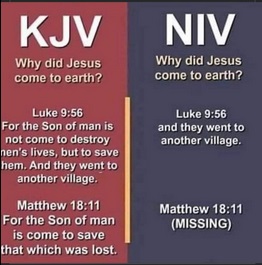
    This is a purported “proof” that the NIV is corrupt. Let’s set aside the accusations toward Zondervan (the publisher), as it is Biblica (not Zondervan) that controls the NIV.

    First, let’s recognize that the KJV that most people read is not the original KJV published in 1611. If it does not say, “feede”, “poore”, “bestowe”, for example, it’s not the 1611 “Authorized Version”. There are the 1760, 1769, 1873, 2005 (supposedly returning to the “true” 1611 with modern spelling) versions. If I understand correctly, the 1873 version is the one most people are referring to when they say KJV.

    The KJV New Testament was translated using the 𝑇𝑒𝑥𝑡𝑢𝑠 𝑅𝑒𝑐𝑒𝑝𝑡𝑢𝑠, which was a compilation of texts gathered by Erasmus starting in 1516. This was the text that King James commanded be the only one used for the KJV, even though other manuscripts were out there. Erasmus (then King James) were the gatekeepers of the selection of manuscripts.

    Other translations, not just the NIV or ESV (which is probably the most KJV adherent modern translation out there), use more than 𝑇𝑒𝑥𝑡𝑢𝑠 𝑅𝑒𝑐𝑒𝑝𝑡𝑢𝑠 to compile, compare, select, and then (ultimately) translate. It is this process that provides confidence in the base aspect of the translation. That the 𝑇𝑒𝑥𝑡𝑢𝑠 𝑅𝑒𝑐𝑒𝑝𝑡𝑢𝑠 had a single person decided which manuscript (including the likelihood that he could not get access to some in other countries) is actually one of the huge red flags when it comes to modern translations.
    In the case of Luke 9:56 (chosen because they made a nice graphic about it), here is a short list of translations that match the NIV: the LEB (possibly the most scholarly conservative version), the REB, the CJB, the ASV (ties with LEB), NRSV, NRSVue, the Darby Version (from 1890!), the CSB, the CEV, the Douay-Rheims (from 1790!), ERV (1895).

    The accuracy of the NIV or ESV isn’t really the issue. What we have is, for many, like rock music was in the 80s for certain Christians (I remember seeing album and book burning in the news). This isn’t about wrong translations. It isn’t about the NIV, per se.

    I’m not sure what this person’s intent was (or those like them). I choose to think that they are trying to honor the Scriptures in this way. However, I believe this dishonors the Scriptures.

    As a pastor, I get to wrestle deeply with the Scriptures, understanding that we Christians have many manuscripts that were transcribed with mostly minor differences. While these differences are big when taken by themselves, in the entire context of the Scriptures, they are small. I’m glad when scholars find an obscure manuscript, because it almost always affirms the New Testament that we have. It’s not something of which to be frightened, or to scare other people about.

    My last thought, though, somewhat aligns with their conclusion. If you are a Christian, you should have at least one hard copy of the Bible. Not because the powers that be will change your Bible on the phone (though they can), but because it is a gift of God that is there (when in hard copy). When the power is out, your internet tanks, or should you (gasp) dare to disconnect from the monstrosity that the internet often is, a hard copy is there.

    John 10:10 (KJV 1611) reads, “The theefe commeth not, but for to steale and to kill, and to destroy: I am come that they might haue life, and that they might haue it more abundantly.”

    The fear that people such as this perpetuate steals and destroys. Fear is not from God.

    And, finally, for all my non-Christian friends, yes, we Christians don’t agree on all things (think of your own family and friends). We do believe, however, that Jesus is the Promised One, the Messiah. It is through him, and him alone, that we will spend eternity with him, as we (try) to change the world into looking more like Heaven on Earth (though we are, admittedly, not doing well in that area).